When homeowners or even contractors talk about waterproofing, the terms roof and terrace are often used interchangeably. But in reality, the two surfaces behave very differently — and so should their waterproofing systems.
This misunderstanding is the reason behind 90% of leak complaints that surface after the first monsoon.
If you’ve ever wondered why a perfectly coated terrace still leaks… this blog is for you.
What’s the Difference Between a Roof and a Terrace?
Before we understand the mistakes, let’s clear the basics:
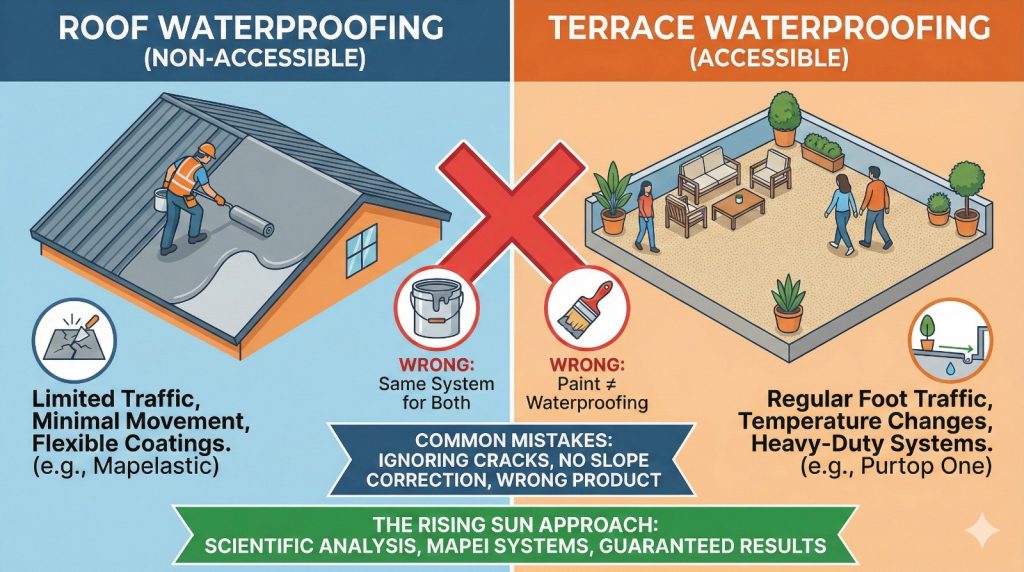
Roof
A roof is typically non-accessible and used only for maintenance.
It usually has:
- No foot traffic
- Minimal structural movement
- Limited exposure to wear & tear
Terrace
A terrace is an actively used space.
It often has:
- Regular foot traffic
- Furniture load
- Higher movement due to temperature changes
- Direct water stagnation if drainage isn’t perfect
Because both behave differently, the waterproofing system must be chosen accordingly.
What Most People Get Wrong (Common Mistakes Explained)
1. Using the Same Waterproofing System for Both
This is the biggest mistake and the root cause of most failures.
A coating meant for roofs cannot handle the traffic and expansion on terraces — it cracks, peels, and creates micro-channels for water to seep through.
Correct Approach:
Choose a traffic-resistant system for terraces and a flexible yet durable system for roofs.
2. Ignoring Cracks Before Coating
People apply waterproofing over cracks and believe the coating will fix it.
It won’t.
Cracks act like veins — water travels quickly through them.
Correct Approach:
- Open cracks
- Fill with elastomeric crack fillers
- Reinforce with mesh where needed
- Then apply waterproofing
3. No Slope Correction
Even the best waterproofing fails when water stagnates.
Terraces require proper slope to allow drainage, but most buildings ignore this step entirely.
Correct Approach:
Ensure at least 1:100 slope before any chemical application.
4. Choosing Paint Instead of Waterproofing
Many apply “waterproof paint” thinking it will stop leaks.
Paint ≠ Waterproofing.
Paint is decorative. Waterproofing is a chemical barrier.
Paint will fade.
Waterproofing will protect.
5. Skipping Reinforcement in Corners & Joints
Corners, parapet walls, pipe junctions — these areas move the most and are the first to leak.
Correct Approach:
Use reinforcement fabric + flexible coatings to strengthen joints.
Roof vs. Terrace Waterproofing: What Should You Actually Use?
Here’s a simple guide that even homeowners can understand:
For Roofs
✔ Flexible liquid membranes
✔ Cementitious waterproof coatings
✔ UV-resistant topcoats
✔ Systems that handle micro-movement but don’t need foot traffic strength
Ideal MAPEI Products:
- Mapelastic AquaDefense
- Planiseal 288 Plus
For Terraces
✔ Heavy-duty elastomeric membranes
✔ Polyurethane-based systems
✔ Reinforcement layers
✔ Ability to withstand heat expansion + foot traffic
Ideal MAPEI Products:
- Purtop One
- Polyurea systems
- Fiber-reinforced coatings
Why Waterproofing Fails — Even When Products Are Good
Because the wrong system is chosen for the wrong surface.
Even the world’s best waterproofing fails if:
- The substrate isn’t prepared
- The cracks aren’t treated
- The slope isn’t corrected
- The surface isn’t primed
- The coating thickness is incorrect
Waterproofing is not a product.
It’s a system.
How Rising Sun Makes the Process Foolproof
At Rising Sun, waterproofing is approached scientifically:
- Site analysis
- Moisture testing
- Crack mapping
- Product selection based on surface behavior
- System application by trained teams
- MAPEI-certified product recommendations
Because when the system is right, the leak will never return.
Final Thoughts
Roof and terrace waterproofing may appear similar, but they require completely different solutions.
Choosing the wrong one can cost you:
- Money
- Time
- Structural damage
- Stress during every monsoon
Choose the right system today, and enjoy leak-free living for years.
About us
We are Rising Sun - a notable brand in the field of construction chemicals. We are authorized distributors for Mapei Construction Chemicals with expertise in providing end-to-end solutions for construction processes including advising to execution.
Contact us
- 8237867922
- info@risingsungroup.co.in
- City Avenue, office no 110, Bhumkar chowk, Wakad Pune 411057